News
Tesla Q3 Update and Its Impact on the Stock
04 Oct 2026, 10:00


Join Minipip Academy and access free courses in investing, trading, economics, and more.
Sign Up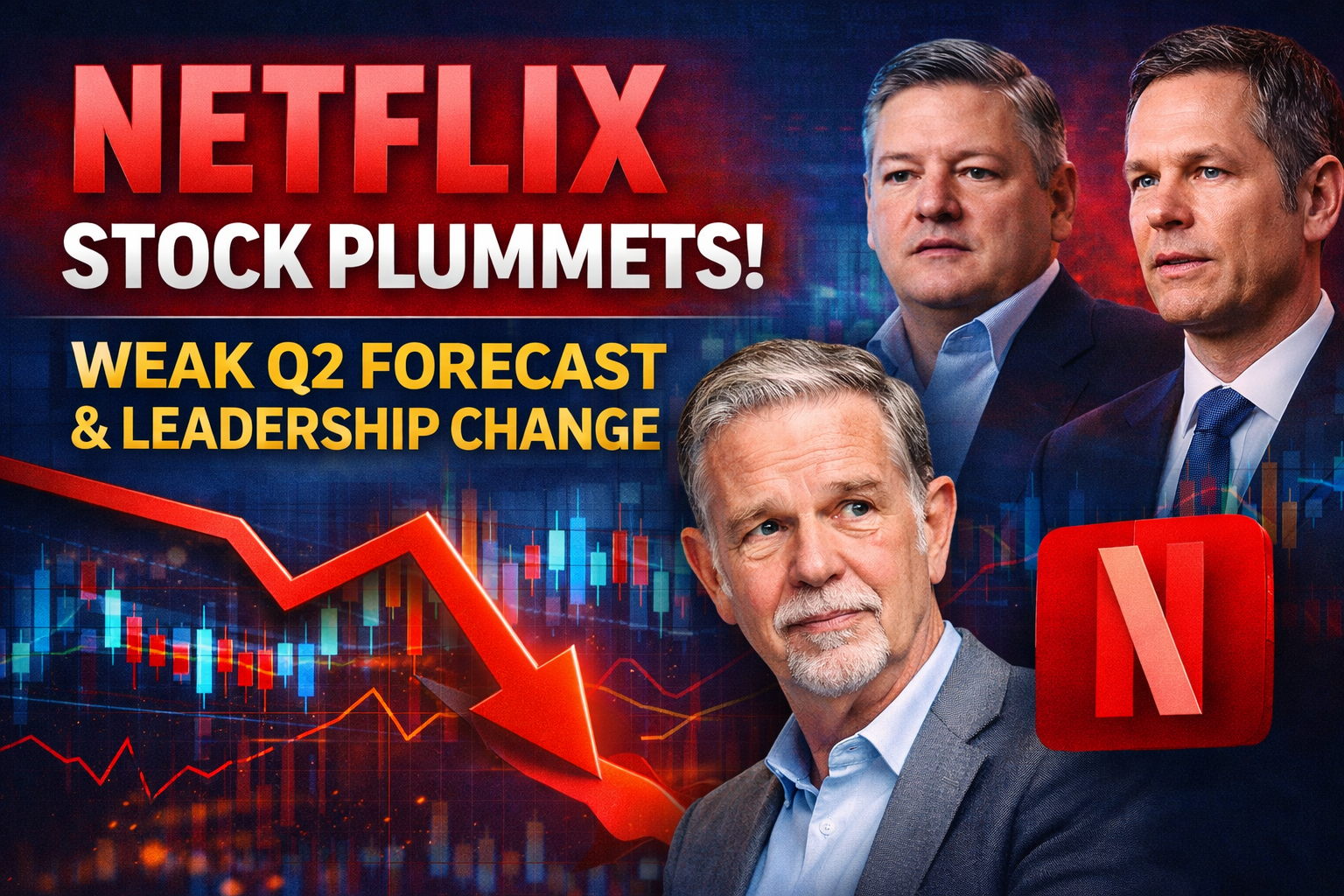
Netflix Stock Slides on Weak Q2 Outlook and Leadership Shift—What It Means for Tech


Shares of Netflix have come under significant pressure following a disappointing second-quarter outlook and a major leadership announcement, raising broader concerns across the technology sector.
The streaming giant saw its stock fall by around 10% after issuing guidance that fell short of Wall Street expectations, despite delivering strong first-quarter earnings.
At first glance, Netflix’s recent earnings appeared solid. The company reported revenue growth of roughly 16% year-on-year, alongside earnings that exceeded analyst expectations.
However, markets are forward-looking—and it was Netflix’s Q2 projections that triggered the sell-off.
This weaker guidance raised concerns about slowing subscriber growth, rising content costs, and the sustainability of recent price increases. Investors had anticipated stronger momentum following earlier optimism, making the miss particularly impactful.
Adding to the uncertainty, co-founder and chairman Reed Hastings announced he will step down from his role after nearly three decades with the company.
While the transition has been described as orderly—with leadership already shared between co-CEOs—markets often react cautiously to the departure of a founding figure.
Hastings played a central role in transforming Netflix from a DVD rental service into a global streaming leader. His exit, even if planned, introduces questions about long-term strategic direction and execution.
Part of the sharp reaction can be attributed to elevated expectations. Netflix stock had surged in recent months, trading at a premium relative to competitors.
This left the company vulnerable to any disappointment. With growth now appearing to slow, investors are reassessing whether Netflix can justify its valuation—particularly in an increasingly competitive streaming landscape.
Netflix’s decline may not be an isolated event. Instead, it highlights a broader theme across technology stocks: markets are becoming less tolerant of growth misses.
Companies such as NVIDIA and Tesla have driven much of the recent market rally. Like Netflix, these firms trade at premium valuations, meaning any slowdown in growth could trigger similar sharp corrections.
Larger, more diversified firms such as Microsoft and Apple may prove more resilient. Their consistent cash flows and diversified revenue streams provide a buffer against short-term disappointments.
Netflix’s outlook also raises concerns for competitors like Disney, particularly around subscriber growth and pricing power in a saturated market.
The key takeaway for investors is clear: expectations matter as much as performance.
If Netflix can stabilise growth through advertising, pricing strategies, and new content formats, the current sell-off may prove temporary. However, failure to reaccelerate growth could lead to further downside.
More broadly, the reaction signals a potential shift in market sentiment—away from unchecked optimism and toward greater scrutiny of earnings quality and forward guidance.
Netflix’s recent decline reflects more than just a weak quarter—it highlights the fragile balance between valuation, growth, and investor expectations.
For the wider tech sector, the message is increasingly clear: in a high-valuation environment, even strong companies are not immune to sharp corrections when expectations fall short.

Tradable assets:
Min.Deposit:
Max Leverage:
FCA:

Rating:
 Earnings Calendar
  Economic Calendar
  VAT Calculator
  Tax Free Childcare Calculator
 Percentage Calculator
 Compound Interest Calculator
  Loan Overpayment Calculator
 Mortgage Calculator
 Credit Card Calculator
 Investing
  Economics
 Trading
  Technical Analysis
  Personal Finance
 Calculator