News
Tesla Q3 Update and Its Impact on the Stock
04 Oct 2026, 10:00


Join Minipip Academy and access free courses in investing, trading, economics, and more.
Sign Up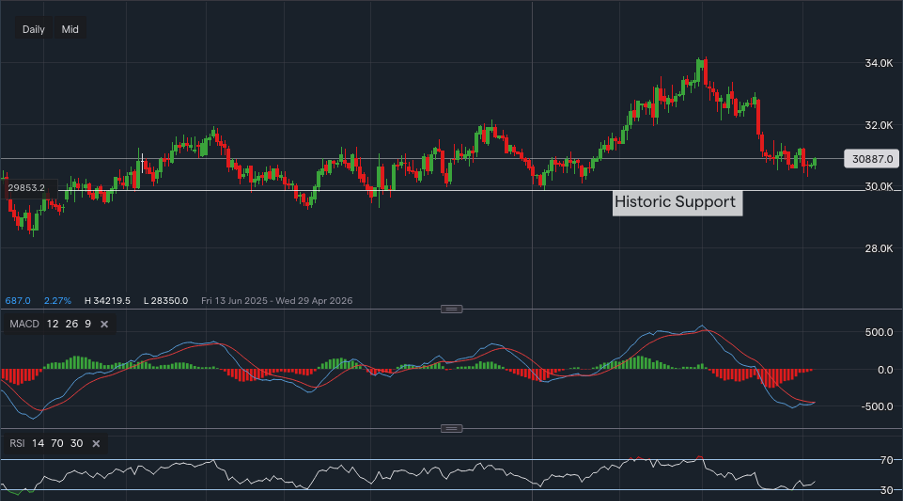
McDonald’s (MCD) Analysis: Defensive Giant at a Technical Crossroads


Front Page
McDonald’s Corp (NYSE: MCD) is a globally dominant player within the consumer cyclical sector, operating at the intersection of quick-service dining and franchised real estate. With approximately 710.6 million shares outstanding and a fully distributed free float, the company benefits from high liquidity and strong institutional participation, making it a staple holding across global equity portfolios. Its scale, brand power, and franchise-driven model position it as a resilient operator within the restaurant industry, capable of delivering consistent cash flows across varying economic cycles.
Fundamental Snapshot
McDonald’s current valuation reflects moderate but stable growth expectations. With a share price of $308.87 and a market capitalisation of $218.99B, the company trades on a trailing P/E of 25.79 and a forward P/E of 21.42, signalling that the market anticipates improved earnings ahead. Earnings are projected to rise from $8.56B to $10.22B, representing an increase of approximately 19.4%, with EPS expected to grow from 11.95 to 14.39.
Applying the Minipip Valuation Model, using an average P/E of 23.61, results in a projected market capitalisation of $241.29B, implying around 10.1% upside from current levels. Overall, this positions McDonald’s as a relatively defensive consumer cyclical, where growth is steady and predictable rather than aggressively priced.
Analyst Consensus & Market Expectations
Analyst sentiment toward McDonald’s remains firmly supportive, with no sell ratings and a clear institutional bias toward accumulation. The average price target of $350 implies approximately 13% upside from current levels, closely aligning with the range derived from the valuation model. This convergence reinforces a well-defined consensus of a fair value zone, suggesting that both market participants and fundamental projections are broadly in agreement on the stock’s near- to medium-term potential.
Price Action & Technical Analysis
From a technical perspective, McDonald’s is currently in a transitional phase. The EMA structure shows short-term weakness, with the 20 EMA below the 50 EMA, while price remains above the 200 EMA, preserving the longer-term bullish trend. This suggests a pullback within a broader uptrend rather than a full structural breakdown. The Ichimoku setup reinforces this view, with price trading below the cloud and the forward cloud turning bearish, indicating a corrective phase rather than trend confirmation.
Momentum indicators further support a bearish short-term outlook. Recent oversold conditions have driven a modest RSI recovery, but momentum still favours continuation of the downtrend before any confirmed reversal; the RSI currently sits at 39 and reflects weakening strength, while a negative MACD confirms that downside momentum remains intact. Directional movement also highlights seller dominance, with –DI above +DI and an ADX reading of 27 signalling an active, established trend rather than a weak or indecisive market. At the same time, expanding Bollinger Bands point to increasing volatility, a condition suggestive of trend continuation.
In terms of price action, the stock is approaching a key historic support zone around $298–300, making this a critical decision point. The current structure follows a sequence of decline followed by consolidation, which often precedes another impulsive move in the direction of the prevailing trend. As such, this setup leans toward continuation rather than reversal, unless clear confirmation signals emerge at support.
Final Recommendation Summary | Conclusion
McDonald’s remains fundamentally solid, with valuation and analyst consensus pointing toward moderate upside potential. However, in the near term, technical indicators show a confirmed downtrend as price approaches a key support zone around $298–300, where either a rebound could re-align price with the longer-term bullish structure, or a breakdown may trigger further downside and continuation of the current bearish momentum.
Recent developments add a nuanced layer to this outlook. On the positive side, strategic partnerships and themed product launches, such as collaborations tied to major entertainment franchises, could provide a short-term boost to sales and customer engagement. Conversely, macroeconomic pressures remain a concern, with elevated fuel costs potentially weighing on consumer spending, particularly in discretionary areas like drive-thru fast food. At the same time, structural shifts in consumer behaviour, including the rising adoption of GLP-1 weight-loss drugs, are beginning to reshape eating habits in the U.S., presenting both a longer-term challenge and an opportunity for adaptation within the restaurant industry.
Educational Disclaimer
This content is for educational and informational purposes only and should not be considered financial advice. Always conduct independent research or consult a qualified financial professional before making investment decisions.

Tradable assets:
Min.Deposit:
Max Leverage:
FCA:

Rating:
 Earnings Calendar
  Economic Calendar
  VAT Calculator
  Tax Free Childcare Calculator
 Percentage Calculator
 Compound Interest Calculator
  Loan Overpayment Calculator
 Mortgage Calculator
 Credit Card Calculator
 Investing
  Economics
 Trading
  Technical Analysis
  Personal Finance
 Calculator