News
What Labour’s Leaked Plans Could Mean for Your Money
10 Oct 2026, 12:26


Join Minipip Academy and access free courses in investing, trading, economics, and more.
Sign Up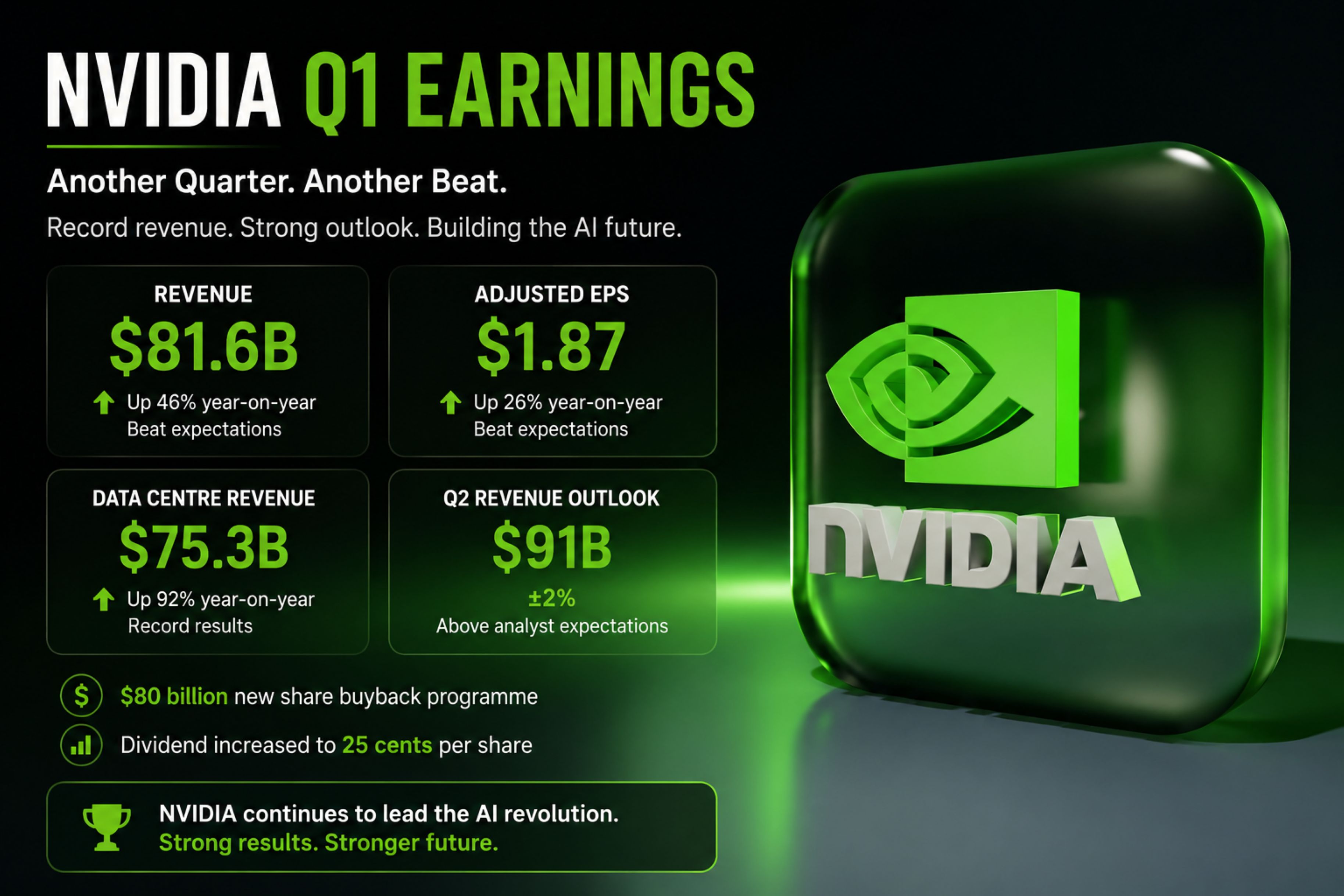
AI


Semiconductor Giant Continues Dominating Artificial Intelligence Market as Investors Debate Valuation
Nvidia has once again delivered record-breaking earnings, reinforcing its position as the global leader in artificial intelligence hardware. However, despite another strong financial performance, some analysts believe expectations surrounding the company have become extremely high.
The AI chipmaker reported stronger-than-expected revenue and earnings while also announcing a massive $80 billion share buyback programme and a dividend increase.
Nvidia shares initially traded slightly lower after the announcement, highlighting growing investor concerns about valuation levels even as the company continues producing exceptional growth.
The company reported first-quarter fiscal 2027 revenue of $81.62 billion, comfortably beating analyst expectations of $79.19 billion. Adjusted earnings per share reached $1.87, compared with forecasts of $1.77.
Nvidia also issued second-quarter revenue guidance of approximately $91 billion, ahead of Wall Street estimates.
AI Demand Continues Driving Nvidia Growth
The rapid global expansion of artificial intelligence infrastructure remains the main driver behind Nvidia’s growth.
The company’s graphics processing units (GPUs) are widely used to power:
Chief executive Jensen Huang described the current AI expansion as “the largest infrastructure expansion in human history”.
Major technology companies including Microsoft, Amazon, Alphabet and Meta continue spending billions on AI infrastructure, which has helped Nvidia dominate the semiconductor sector.
Data centre revenue surged 92% year-on-year to a record $75.25 billion.
Why Investors Are Concerned About Valuation
Despite Nvidia’s exceptional financial results, some analysts believe the company’s valuation now reflects near-perfect expectations.
Since the AI boom began in late 2022, Nvidia’s market capitalisation has grown to more than $5 trillion, making it one of the world’s most valuable publicly traded companies.
Analysts noted that even strong earnings reports may no longer trigger major share price rallies because investors already expect extraordinary growth.
Concerns currently affecting sentiment include:
China remains a major challenge for Nvidia after US export controls significantly reduced its ability to sell advanced AI chips into the country. The company confirmed there were no Hopper data centre shipments to China during the quarter.
Nvidia Introduces New Reporting Structure
Nvidia also announced changes to its reporting framework to better reflect its future growth strategy.
The company will now focus reporting around two core divisions:
Edge Computing will include areas such as robotics, AI-powered PCs, gaming systems and automotive technology.
Analysts believe this shift reflects Nvidia’s ambition to expand beyond cloud AI infrastructure into broader real-world AI applications.
Conclusion for Investors
Nvidia remains one of the strongest companies benefiting from the global artificial intelligence boom. Record revenue growth, dominant market share and continued demand for AI infrastructure continue supporting long-term optimism around the stock.
However, investors should recognise that expectations for Nvidia are now exceptionally high. Even strong earnings may not guarantee major share price gains if growth slows or valuations become stretched.
For long-term investors, Nvidia still appears well positioned within the AI sector, but volatility may increase as competition, regulation and global economic conditions evolve throughout 2026.
Sources: (Investing.com, Reuters.com)

Tradable assets:
Min.Deposit:
Max Leverage:
FCA:

Rating:
 Earnings Calendar
  Economic Calendar
  VAT Calculator
  Tax Free Childcare Calculator
 Percentage Calculator
 Compound Interest Calculator
  Loan Overpayment Calculator
 Mortgage Calculator
 Credit Card Calculator
 Investing
  Economics
 Trading
  Technical Analysis
  Personal Finance
 Calculator