News
News in Brief
21 Sep 2026, 16:23


Join Minipip Academy and access free courses in investing, trading, economics, and more.
Sign Up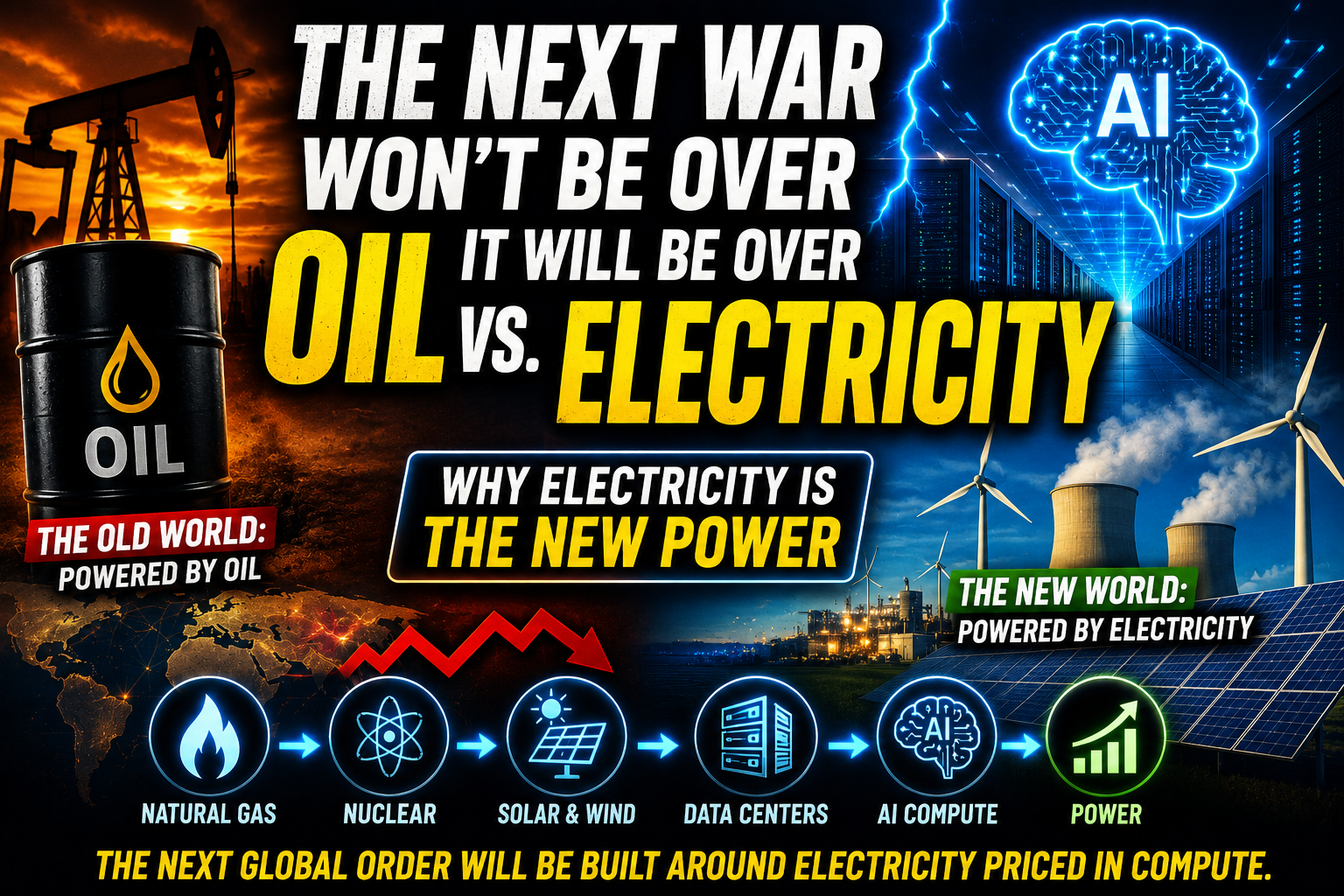
Why Electricity Could Become the World’s Most Powerful Asset


For decades, oil has been one of the most important resources in the global economy. Countries fought over it, traded it in US dollars, and built entire industries around it. But according to many market analysts, the next major global battle may not be over oil at all — it could be over electricity.
The reason is simple: artificial intelligence needs enormous amounts of power.
Many new investors believe the AI boom is mainly about computer chips made by companies like NVIDIA. But experts say chips are only part of the story. The real challenge is generating enough electricity to power massive AI data centres.
Every AI system — from chatbots to robotics and military software — runs inside giant facilities packed with servers. These centres consume huge amounts of electricity every second to process information and train AI models.
That is changing how investors think about energy.
In the past, oil powered cars, planes, and factories. Today, AI depends mostly on grid electricity, which is produced through sources like natural gas, nuclear power, solar energy, and wind farms. Oil now makes up only a small part of electricity generation in many developed countries.
As a result, companies connected to electricity production are attracting growing attention from traders. Nuclear energy, in particular, has returned to the spotlight because it can provide large amounts of stable power around the clock.
Analysts say this creates a new chain in the market: natural gas and nuclear create electricity, electricity powers data centres, and data centres create AI systems that generate economic and military advantages.
For beginner traders, the key takeaway is that the AI investment trend may be much bigger than just technology stocks. Energy producers, utility companies, and infrastructure businesses could also become major winners in the years ahead.
Some investors now believe the next global economy will not be built around oil prices — but around access to electricity and computing power.

Tradable assets:
Min.Deposit:
Max Leverage:
FCA:

Rating:
 Earnings Calendar
  Economic Calendar
  VAT Calculator
  Tax Free Childcare Calculator
 Percentage Calculator
 Compound Interest Calculator
  Loan Overpayment Calculator
 Mortgage Calculator
 Credit Card Calculator
 Investing
  Economics
 Trading
  Technical Analysis
  Personal Finance
 Calculator