News
Tesla Q3 Update and Its Impact on the Stock
04 Oct 2026, 10:00


Join Minipip Academy and access free courses in investing, trading, economics, and more.
Sign Up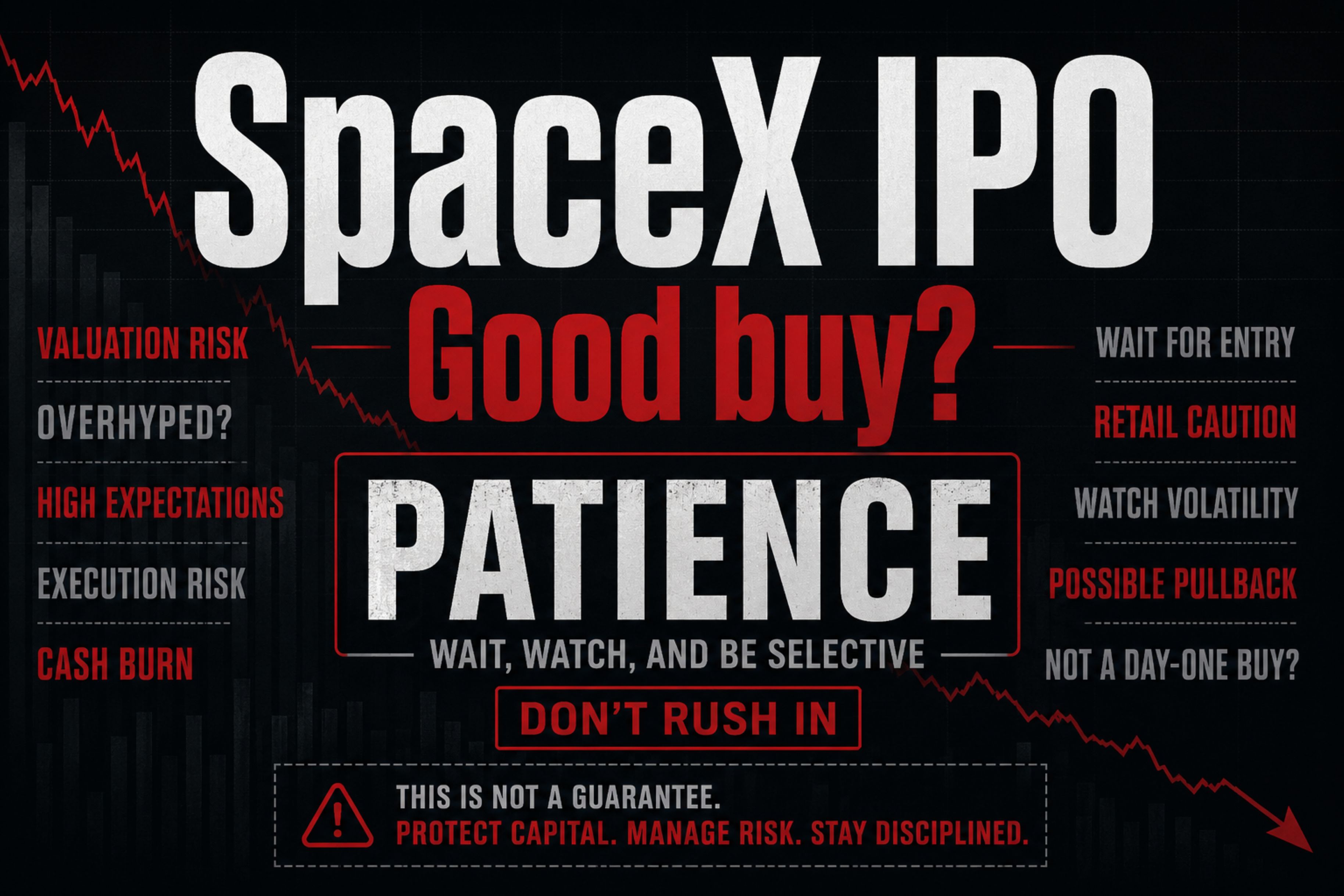
AI


The world’s biggest IPO could reshape investor appetite for technology stocks.
The SpaceX IPO is expected to be one of the most important stock market events of 2026. Elon Musk’s space and satellite business is reportedly aiming to raise around $75 billion at $135 per share, giving the company a valuation of about $1.75 trillion. If completed, it would be the largest initial public offering in history.
SpaceX is expected to trade on the Nasdaq under the ticker SPCX. Demand is already strong, with Reuters reporting that the offer is around two times oversubscribed. Unusually, about 30% of the IPO has reportedly been set aside for retail investors, giving ordinary buyers more access than they normally receive in a major listing.
The excitement is easy to understand. SpaceX has several powerful growth stories:
However, the valuation is difficult to justify using traditional measures. Reuters has reported that Starlink is the only profitable part of SpaceX. In the first quarter, Starlink made an operating profit, but the wider company still recorded an operating loss of $1.94 billion on $4.69 billion of revenue. Its AI division alone lost $2.47 billion.
That makes the IPO potentially dangerous for investors buying at the start. A $1.75 trillion valuation prices in years of perfect execution. It assumes that Starlink keeps growing, Starship succeeds, launch demand expands and the AI business eventually becomes highly profitable. Any delay, cost overrun or weaker-than-expected revenue could put pressure on the share price.
There is also a wider market risk. Large IPOs can pull money away from existing technology shares, especially when investors sell holdings to raise cash. This may add pressure to AI, semiconductor and high-growth tech stocks that have already risen sharply. If SpaceX trades strongly at first, it could attract momentum buyers. But if it struggles, it may damage confidence across the wider tech sector.
Another issue is index inclusion. Reuters has reported that SpaceX will not immediately qualify for the S&P 500 because it must meet rules around public trading history, profitability and free float. That means some passive funds may not be forced to buy straight away.
Should investors wait?
SpaceX may become one of the most important companies of the next decade, but that does not automatically make the IPO a good buy on day one. The opening price may be inflated by hype, scarcity and Elon Musk’s reputation.
For potential investors, waiting may be the smarter move. The stock could spike at first, but it may also fall once early excitement fades and the market focuses on losses, valuation and execution risk. A more attractive entry point may appear after the first few months of trading, when investors can judge results, cash burn and market demand more clearly.

Tradable assets:
Min.Deposit:
Max Leverage:
FCA:

Rating:
 Earnings Calendar
  Economic Calendar
  VAT Calculator
  Tax Free Childcare Calculator
 Percentage Calculator
 Compound Interest Calculator
  Loan Overpayment Calculator
 Mortgage Calculator
 Credit Card Calculator
 Investing
  Economics
 Trading
  Technical Analysis
  Personal Finance
 Calculator