News
What Labour’s Leaked Plans Could Mean for Your Money
10 Oct 2026, 12:26


Join Minipip Academy and access free courses in investing, trading, economics, and more.
Sign Up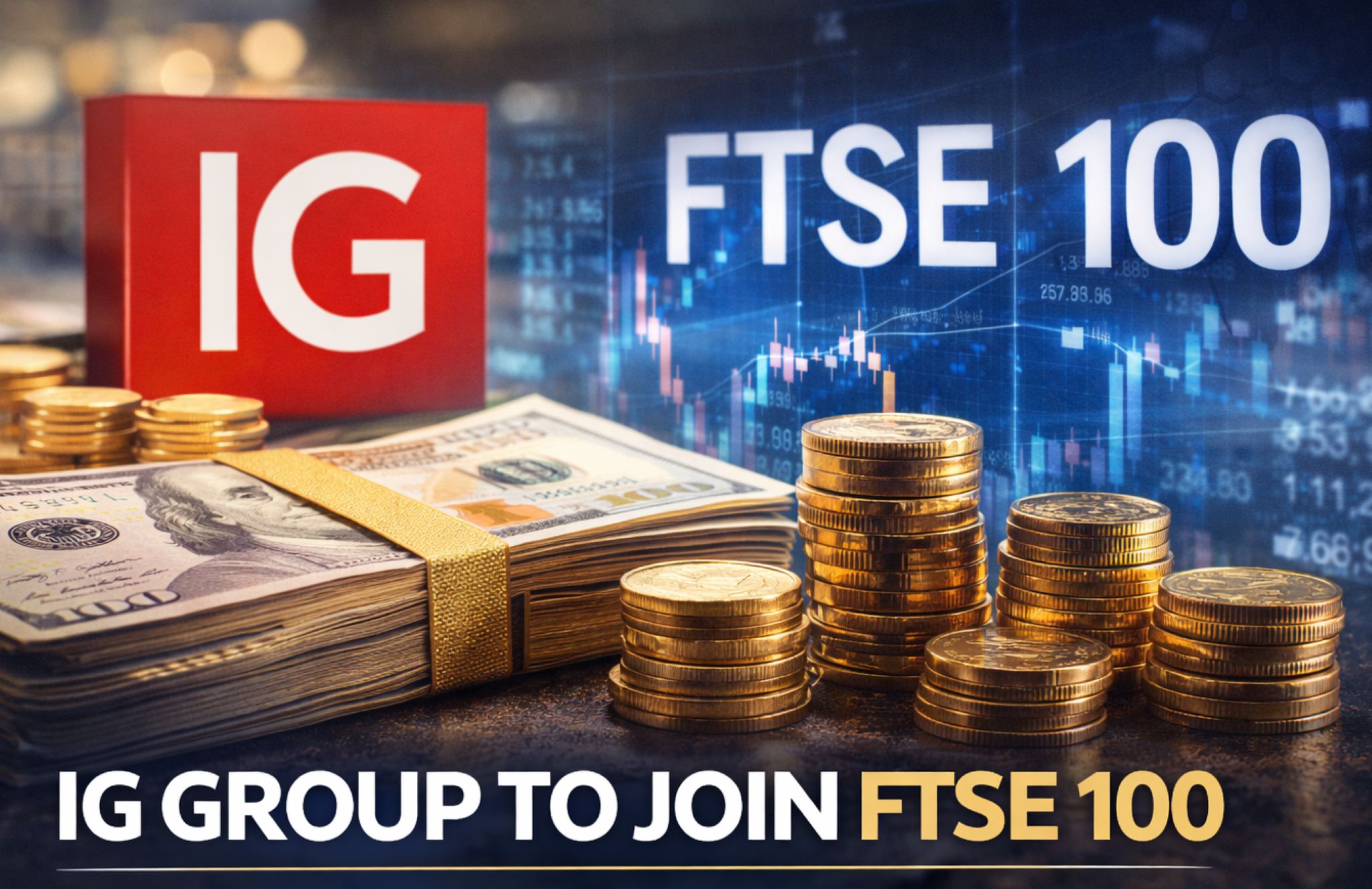
AI


London Stock Exchange index reshuffle signals upgrade for online trading firm
IG Group Holdings plc — the UK-based online trading and investment platform — is poised to join the FTSE 100 Index, replacing established names such as EasyJet and Rightmove following the latest quarterly review by FTSE Russell. The potential inclusion reflects IG Group’s rising market value and growing shareholder base.
The promotion from the FTSE 250 to the FTSE 100 would be a major milestone for the financial-services firm and underscores its increasing relevance in global markets.
What the FTSE 100 Inclusion Means
The FTSE 100 Index comprises the 100 largest companies listed on the London Stock Exchange (LSE) by market capitalisation. Inclusion in the FTSE 100 is determined quarterly based on market size, share liquidity and other technical requirements, with companies taking the place of others whose market value has fallen relative to peers.
Key points about IG’s anticipated promotion:
This reshuffle typically happens once a quarter and reflects shifting market valuations and investor flows across UK stocks.
Why IG Group Is Rising Through the Ranks
IG Group’s improving index position is supported by stronger company performance and expansion initiatives:
The company’s market capitalisation of around £4.5 billion is now approaching the threshold typically required for FTSE 100 entry, bridging the gap with larger constituents.
How FTSE 100 Inclusion Could Affect IG Group’s Share Price
Joining the FTSE 100 could have several implications for IG Group’s shares:
Historically, stocks promoted to the FTSE 100 have seen positive share-price reactions around the rebalancing date, although performance can vary based on wider market conditions. Investors should consider both potential upside from index inclusion and macroeconomic factors that affect broader sentiment.
Market and Exchange Context
The FTSE 100 is widely regarded as a barometer of UK market health, incorporating the biggest companies listed in London. Rankings are reviewed quarterly to ensure the index reflects current market capitalisation standings.
IG’s likely promotion follows a period of reassessment among travel and consumer stocks — notably EasyJet and Rightmove — whose relative valuations have declined, opening the way for financial firms such as IG to ascend.
Outlook for Investors
For existing IG Group shareholders, FTSE 100 inclusion could offer:
However, investors should remain mindful that longer-term share performance also depends on company earnings, regulatory developments and overall market conditions.
Sources: (MotleyFool.com, YahooFinance.com)
Tradable assets:
Min.Deposit:
Max Leverage:
FCA:

Rating:
 Earnings Calendar
  Economic Calendar
  VAT Calculator
  Tax Free Childcare Calculator
 Percentage Calculator
 Compound Interest Calculator
  Loan Overpayment Calculator
 Mortgage Calculator
 Credit Card Calculator
 Investing
  Economics
 Trading
  Technical Analysis
  Personal Finance
 Calculator