News
What Labour’s Leaked Plans Could Mean for Your Money
10 Oct 2026, 12:26


Join Minipip Academy and access free courses in investing, trading, economics, and more.
Sign Up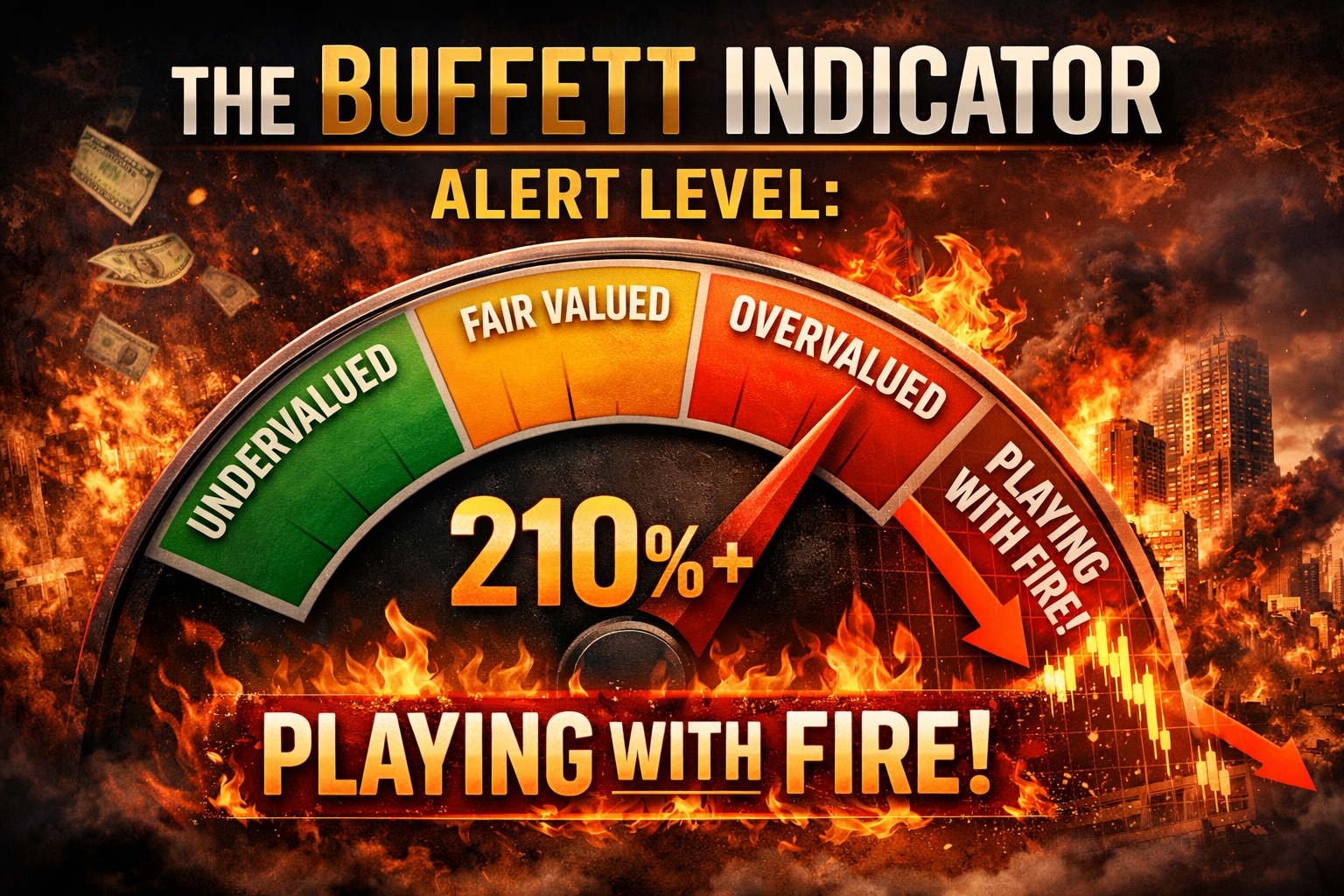
Buffett Indicator Flashes Warning as Market Valuations Stretch Beyond Economic Reality


A closely watched valuation metric often associated with Warren Buffett is once again drawing attention on Wall Street, as it signals that U.S. equities may be significantly overvalued—raising concerns that a market correction, or even a deeper crash, could be on the horizon.
The so-called “Buffett Indicator,” which compares the total value of the U.S. stock market to the country’s gross domestic product (GDP), has climbed back toward historically extreme levels. For many investors, that is a red flag.
A Simple Metric With Powerful Implications
At its core, the Buffett Indicator measures the ratio between total market capitalisation and GDP—effectively asking a simple question: Are stock prices aligned with the size of the real economy?

When this ratio rises significantly above historical norms, it suggests that equities are priced far beyond what underlying economic output might justify.
Recent readings have pushed well above 200%, a level that has historically preceded major market drawdowns—including the dot-com bubble and the 2008 financial crisis.
Warren buffet describes a ratio of <75% undervalued, 75-100% as fair value, 100-150% as overvalued, 150-200% as significantly overvalued, and finally >200% as “playing with fire”
Markets Enter “Overextended” Territory
The current surge in valuations has been driven largely by strength in the S&P 500, particularly within mega-cap technology firms. Companies such as Apple, Microsoft, and NVIDIA have propelled indices higher, accounting for a disproportionate share of recent gains.
While earnings growth has been strong, critics argue that price appreciation has outpaced fundamentals. The result is a market that appears increasingly detached from the broader economy.
This disconnect is precisely what the Buffett Indicator is designed to highlight.
Why Investors Are Taking Notice
The concern is not simply that valuations are high—it’s that they are high relative to economic capacity. GDP growth, while steady, has not accelerated at the same pace as equity markets.
This imbalance creates several risks:
In effect, the higher the ratio climbs, the thinner the cushion becomes.
Implications Across Asset Classes
A potential correction driven by valuation concerns would not impact all assets equally. Instead, it could trigger a broad reallocation of capital:
Blue-chip tech
High-growth, high-multiple stocks are often the most vulnerable during valuation resets. Even modest shifts in sentiment could lead to outsized declines in major tech names.
Gold
Gold may benefit as investors rotate into safe-haven assets. Historically, gold performs well during periods of equity market stress and uncertainty.
Oil
Crude Oil is less directly tied to equity valuations but could face pressure if a market downturn signals weaker future demand. However, geopolitical factors may offset this.
Broader equities
The S&P 500 itself could see broad-based declines, particularly if passive investment flows begin to reverse.
Defence stocks
Companies like Lockheed Martin and BAE Systems may prove more resilient, especially if geopolitical tensions remain elevated, supporting government spending.
Not a Timing Tool—But a Warning Signal
It’s important to note that the Buffett Indicator is not a precise timing mechanism. Markets can remain overvalued for extended periods, particularly in environments with strong liquidity and investor optimism.
However, at extreme levels, it has historically served as a reliable warning sign that future returns may be lower—and risks higher.
Even Warren Buffett himself has cautioned that when the ratio gets too high, “you are playing with fire.”
What Comes Next
The key question now is whether markets will correct gradually or abruptly. A slow adjustment could see valuations normalise through earnings growth and sideways price movement. A sharper correction, however, could be triggered by external shocks—ranging from interest rate changes to geopolitical events.
For investors, the message is increasingly difficult to ignore: valuations are stretched, expectations are high, and the margin for error is narrowing.
Whether or not a crash is imminent, the Buffett Indicator is once again reminding markets of a fundamental truth—prices cannot outpace reality forever.

Tradable assets:
Min.Deposit:
Max Leverage:
FCA:

Rating:
 Earnings Calendar
  Economic Calendar
  VAT Calculator
  Tax Free Childcare Calculator
 Percentage Calculator
 Compound Interest Calculator
  Loan Overpayment Calculator
 Mortgage Calculator
 Credit Card Calculator
 Investing
  Economics
 Trading
  Technical Analysis
  Personal Finance
 Calculator