News
AI Spending Risks: Could Rising Costs Put Technology Stock Prices Under Pressure?
28 Oct 2026, 15:36


Join Minipip Academy and access free courses in investing, trading, economics, and more.
Sign Up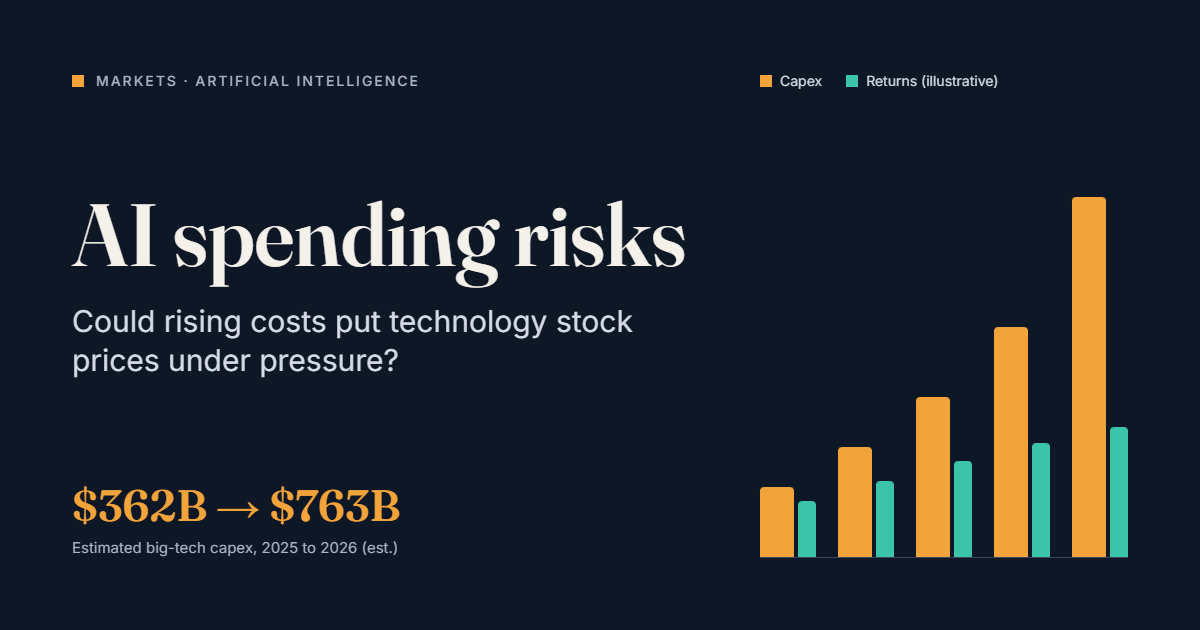


The technology sector continues to invest heavily in artificial intelligence (AI), with some of the world's largest technology companies committing hundreds of billions of dollars to data centres, advanced processors and cloud computing infrastructure. While this investment reflects growing demand for AI services, it is also raising an important question for investors: will the revenue generated by these technologies be enough to justify their rapidly increasing costs? As the market evaluates the next stage of the AI boom, attention is shifting beyond headline revenue growth towards profitability, cash flow and the long-term financial returns of these investments.
Why AI Infrastructure Spending Is Becoming a Concern
Companies such as Microsoft, Alphabet, Amazon and Meta Platforms are competing to expand their AI capabilities. This requires substantial investment in specialised chips, servers, networking equipment, electricity and data centre facilities. Although these investments could strengthen their competitive positions over time, the financial benefits may not arrive as quickly as the costs.
According to S&P Global Market Intelligence, consensus estimates published on 26 October 2026 projected that capital expenditure by major cloud and technology infrastructure providers could reach approximately $763 billion in 2026, compared with $362 billion in 2025. The projected increase highlights the scale of the industry's commitment to AI infrastructure and the pressure this could place on margins if spending continues to grow faster than revenue. These are estimates rather than confirmed final spending figures, and actual investment may differ.
Strong Revenue Growth May Not Be Enough to Support Share Prices
One of the biggest challenges facing technology companies is demonstrating that increased AI expenditure can translate into sustainable earnings growth. Investors may initially welcome stronger cloud revenue, expanding AI adoption and rising demand for computing capacity. However, if the cost of delivering these services rises at a similar or faster pace, the improvement in profitability could be less impressive than expected.
This creates a potentially difficult environment for highly valued technology stocks. Share prices are influenced not only by a company's current performance but also by expectations for its future earnings. If investors believe that AI investments will generate substantial returns over time, they may be willing to support higher valuations. If those returns appear uncertain or are delayed, however, the market could reassess how much it is prepared to pay for future growth.
Recent developments at Alphabet illustrate this tension. In July 2026, the company raised its full-year capital expenditure forecast to between $195 billion and $205 billion as it continued expanding its AI infrastructure. Although its cloud business delivered strong growth, the higher spending commitment attracted scrutiny over cash flow and the financial returns expected from its investments. This demonstrates why positive operating performance does not always translate into an immediate rise in a company's share price.
Free Cash Flow: A Key Measure for Technology Investors
Free cash flow is likely to remain an important measure as investors assess the financial sustainability of the AI boom. It represents the cash a company generates after accounting for capital expenditure and is often used to evaluate its ability to fund future investment, reduce debt, return capital to shareholders or withstand weaker economic conditions.
When infrastructure spending increases sharply, free cash flow can come under pressure even if revenue continues to grow. Companies may need to devote a greater proportion of their operating cash to building and maintaining AI systems, potentially reducing the funds available for share buybacks, dividends or other strategic priorities.
This does not necessarily mean that heavy investment is a negative development. Infrastructure projects can take time to become productive, and spending today may support substantial revenue in future years. The concern arises when expenditure continues to increase without clear evidence that the resulting business growth can eventually deliver adequate returns. Investors will therefore be watching for signs that AI demand is translating into stronger cash generation rather than simply requiring further rounds of investment.
Could AI Spending Trigger a Pullback in Technology Stocks?
The relationship between AI investment and technology share prices could become increasingly important as investors distinguish between companies capable of monetising AI and those whose expenditure may take longer to generate meaningful returns.
A potential bearish scenario could develop if companies increase their capital expenditure forecasts while providing limited evidence of improving profitability. If earnings guidance disappoints, free cash flow weakens or financing costs rise, investors may become less willing to support elevated valuations. Under these circumstances, technology stocks could experience increased volatility or a potential pullback as market expectations adjust.
There is also a risk that AI infrastructure becomes available faster than companies can monetise the capacity they are building. If demand growth slows, competition intensifies or customers become more sensitive to pricing, the returns on expensive infrastructure could fall short of expectations. Higher depreciation costs and additional operating expenses could further complicate the outlook.
Nevertheless, a market wide decline is not inevitable. Companies with strong balance sheets, established customer relationships, recurring revenue and clear evidence of AI-related demand may be better positioned to absorb elevated investment costs. The market could also continue rewarding businesses that demonstrate that their AI infrastructure is generating measurable improvements in revenue and profitability.
What Investors Should Watch Next
The upcoming earnings announcements and management guidance from major technology companies will be important in assessing whether the current investment cycle is sustainable. Investors are likely to focus on cloud revenue growth, AI-related demand, capital expenditure forecasts, operating margins and free cash flow. The relationship between these measures may provide a clearer picture of whether investment is beginning to produce the financial results that the market expects.
Microsoft and Alphabet are particularly relevant to this discussion, with both scheduled to report quarterly results on 28 October 2026. Their announcements could provide further insight into how AI investment is affecting business growth, costs and future spending plans. Amazon's results, expected on 29 October, will also be relevant to the broader debate surrounding cloud infrastructure and AI monetisation.
For the technology sector, the key issue is not simply whether companies continue investing in artificial intelligence. It is whether they can demonstrate a credible path towards generating sufficient revenue, earnings and cash flow to justify that investment. Strong demand could continue to support the sector, but rising costs and uncertain returns may create greater differences in performance between individual companies.
Can the AI Boom Sustain Technology Stock Valuations?
The AI investment boom remains a significant long-term development for the technology sector, but its next phase may depend increasingly on financial discipline and measurable returns. Expanding infrastructure could create new revenue opportunities, strengthen cloud services and support the development of more advanced AI products. At the same time, rising capital expenditure, pressure on free cash flow and uncertainty over future profitability could limit the upside potential of some technology shares.
The outlook is therefore mixed. If major technology companies demonstrate that AI investment is translating into sustainable earnings and stronger cash generation, investor confidence could improve and provide support for share prices. If expenditure continues to accelerate without sufficient financial returns, valuations could come under pressure and market volatility could increase.
Ultimately, the sustainability of the AI boom may depend on whether the industry's enormous infrastructure investments can deliver the long-term economic benefits that investors are anticipating. For now, the balance between growth, spending and profitability remains one of the most important factors to monitor when assessing the technology sector's potential direction.

Tradable assets:
Min.Deposit:
Max Leverage:
FCA:

Rating:
 Earnings Calendar
 Economic Calendar
 VAT Calculator
 Tax Free Childcare Calculator
 Percentage Calculator
 Compound Interest Calculator
 Loan Overpayment Calculator
 Mortgage Calculator
 Credit Card Calculator

 Investing
 Economics
 Trading
 Technical Analysis
 Personal Finance
 Calculator