News
What Labour’s Leaked Plans Could Mean for Your Money
10 Oct 2026, 12:26


Join Minipip Academy and access free courses in investing, trading, economics, and more.
Sign Up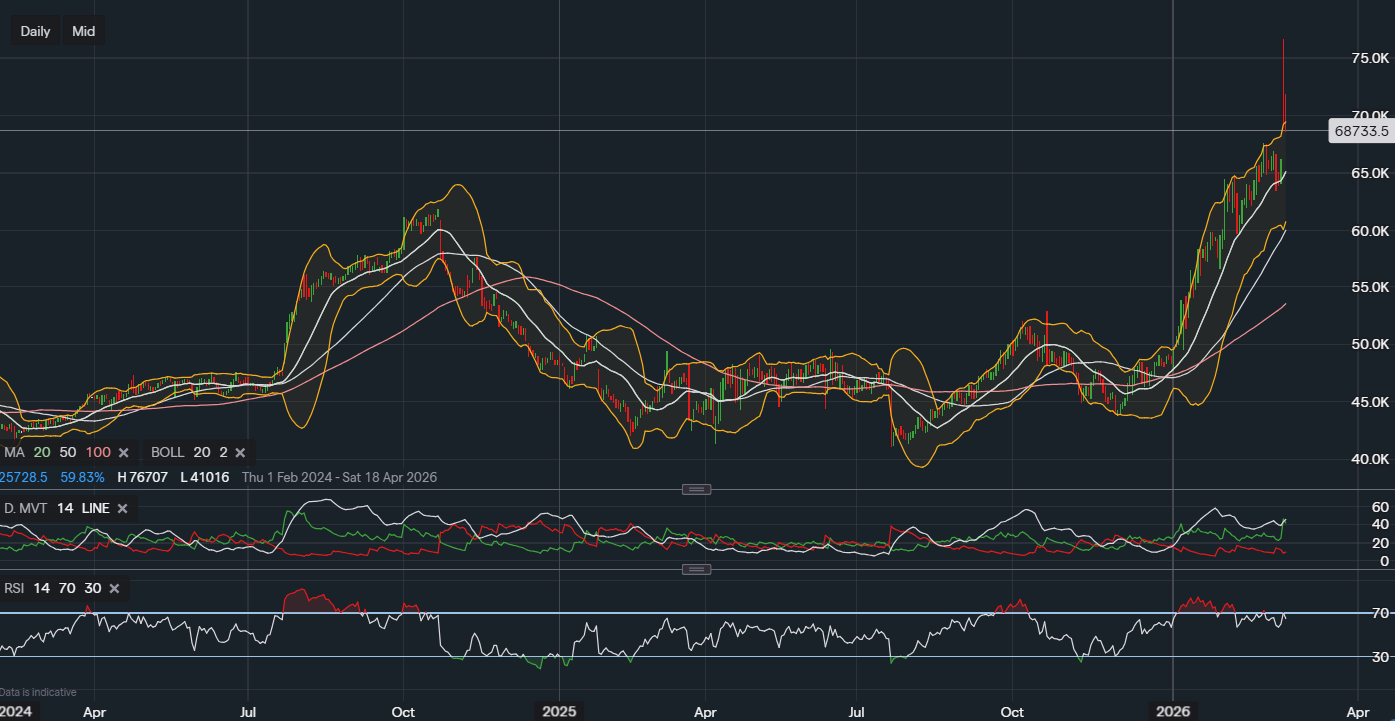
Lockheed Martin Stock Analysis: Technical & Fundamental Outlook (2026)


Lockheed Martin is a leading American aerospace, defence, security and advanced technology company. The company designs, develops, manufactures and supports high-technology systems and services primarily for governments and armed forces worldwide. Its core areas include:
Military aircraft (including advanced fighter jets)
Missile and missile defence systems
Space systems and satellites
Cyber security and advanced mission technologies
Lockheed Martin is one of the world’s largest defence contractors and a key supplier to the United States Department of Defense and allied nations.
Following recent geopolitical tensions involving Iran, Israel and the United States, speculation around potential escalation of military activity has increased. Historically, periods of geopolitical uncertainty often benefit defence stocks, as investors anticipate higher military spending and future government contracts.
This sentiment has contributed to upward momentum in Lockheed Martin’s share price, as traders position for possible revenue growth.
The RSI indicates that Lockheed Martin has been heavily overbought, remaining above 70 for much of the past two months.
RSI above 70 = Overbought conditions
Prolonged overbought readings = Increased probability of pullback
This suggests caution for short-term traders.
The current share price is trading above the upper Bollinger Band, typically signalling:
Elevated volatility
Potential price exhaustion
Increased likelihood of mean reversion
When price consistently trades above the upper band, it often precedes consolidation or a short-term correction.
A noticeable gap up occurred between 27 February and 1 March, indicating strong buying pressure. However, price gaps can act as magnets for future retracements, especially if momentum slows.
Despite overbought conditions, the Directional Movement Index shows a strong bullish trend. A rising ADX above 25–30 typically confirms strong trend strength.
This suggests that while a reversal may eventually occur, the bullish momentum could persist in the near term.
Key support levels sit below the current share price, including:
20-day exponential moving average (EMA)
50-day EMA
100-day EMA
These levels may provide downside support if a correction occurs.
Current P/E Ratio: 30.63
Forward P/E Ratio: 20.61
A P/E of 30.63 suggests the company is trading at a premium relative to traditional defence sector averages. However, the lower forward P/E implies analysts expect earnings growth, which improves relative valuation.
High valuation target: $1,038.04 (48.61% upside)
Conservative target: $868.31 (24.31% upside)
However, broader analyst consensus places the average price target around $642.93, implying approximately 2.3% downside from current levels and a general rating of “Hold”.
This suggests that, despite strong earnings expectations, the stock may already reflect much of the anticipated growth.
RSI overbought conditions
Price above upper Bollinger Band
Recent gap up
Elevated volatility
These factors increase the probability of a pullback or consolidation.
Strong defence sector positioning
Solid earnings outlook
Lower forward P/E suggesting improving value
However, valuation relative to analyst price targets suggests limited upside at current levels.
While Lockheed Martin demonstrates strong fundamentals and benefits from favourable geopolitical tailwinds, technical indicators point to overbought conditions and heightened volatility.
For risk-averse investors, current price levels may present elevated risk. For momentum traders, the strong bullish trend could continue in the short term — but caution is warranted.
As always, investors should consider their risk tolerance, time horizon and portfolio diversification before making investment decisions.

Tradable assets:
Min.Deposit:
Max Leverage:
FCA:

Rating:
 Earnings Calendar
  Economic Calendar
  VAT Calculator
  Tax Free Childcare Calculator
 Percentage Calculator
 Compound Interest Calculator
  Loan Overpayment Calculator
 Mortgage Calculator
 Credit Card Calculator
 Investing
  Economics
 Trading
  Technical Analysis
  Personal Finance
 Calculator