News
What Labour’s Leaked Plans Could Mean for Your Money
10 Oct 2026, 12:26


Join Minipip Academy and access free courses in investing, trading, economics, and more.
Sign Up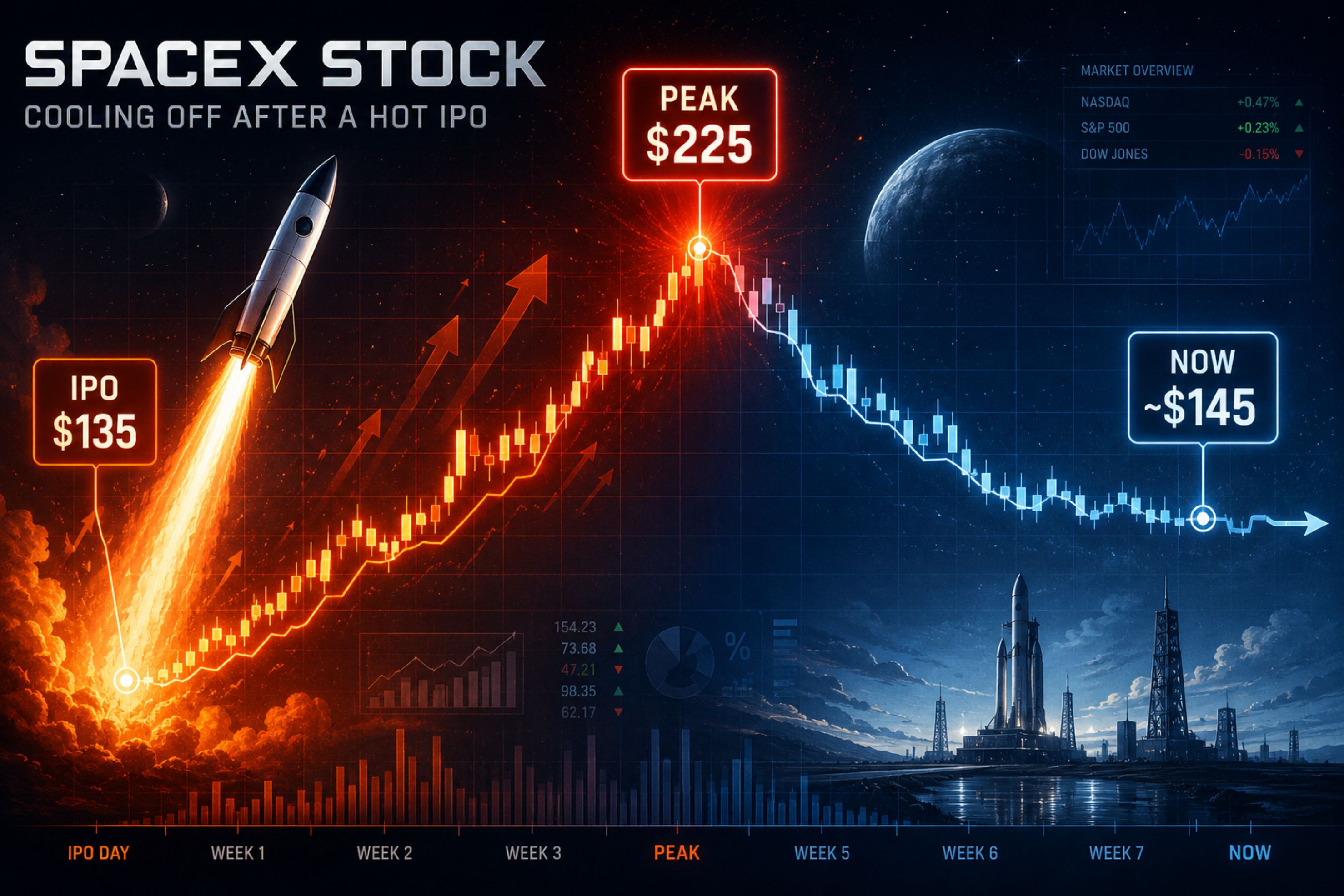
AI


SpaceX’s first month as a publicly traded company has been dramatic. The company’s IPO on 12 June was met with heavy demand, with shares priced at $135 before jumping sharply on the first day of trading. At one point, the stock reached $225, briefly placing SpaceX among the most valuable companies in the world.
However, the early excitement has cooled. By the end of its first month on the market, SpaceX shares were trading at around $145, well below their peak. That still leaves early IPO investors ahead, but many retail investors who bought during the first few days may now be sitting on losses.
Much of the initial hype came from investors treating SpaceX as more than a rocket business. The company has increasingly been viewed as a broader technology platform, combining:
Recent reports suggest demand for the IPO was extremely strong, with Reuters saying the offering attracted more than $250 billion of investor orders and became heavily oversubscribed. The final IPO proceeds reportedly rose to $85.7 billion after underwriters exercised their option to sell additional shares.
The difficulty for investors is valuation. Reuters previously reported that SpaceX had 2025 revenue of about $18.67 billion, meaning the company’s IPO valuation implied a very high price-to-revenue multiple. That leaves little room for disappointment if growth slows or future projects take longer than expected.
For markets, SpaceX matters because it has become a test of investor appetite for large, ambitious technology listings. Its IPO has also helped Wall Street banks, with Reuters reporting that capital markets and trading activity linked to the SpaceX float supported expectations for stronger bank earnings.
The bigger question is what this means for Elon Musk’s wider group of companies. Tesla investors may now compare Tesla’s growth story directly with SpaceX, especially as SpaceX offers exposure to rockets, satellites, AI and communications. This could either strengthen the “Musk ecosystem” narrative or put pressure on Tesla if investors see SpaceX as the more exciting growth vehicle.

There may also be concerns around complexity. Musk controls or influences several major companies, including Tesla, SpaceX, X, xAI-linked operations, Neuralink and The Boring Company. Morningstar has highlighted that this creates potential governance and conflict-of-interest risks, especially where capital, talent or technology overlap between businesses.
Speculation around a possible Tesla and SpaceX combination may also continue. Some analysts and market commentators have questioned whether a merger could eventually be considered, although such a move would be complicated and could raise major questions for Tesla shareholders.
Summary
SpaceX’s IPO was historic, but the first month has shown how quickly enthusiasm can turn into caution. The company still has enormous long-term potential, but investors are now looking beyond the Musk name and asking harder questions about revenue, losses, valuation and execution.
Conclusion
For markets, SpaceX could remain one of the most important stocks to watch. Strong earnings, Starlink growth or progress in AI and space infrastructure could reignite momentum. But if the company disappoints, the impact may spread beyond SpaceX and affect sentiment towards Tesla, AI stocks, IPOs and other Musk-linked businesses.
For investors, the opportunity is significant, but so is the risk. SpaceX may become one of the defining companies of the next decade, but at this valuation, it needs to deliver extraordinary growth to justify the price.
Sources: (Reuters.com, BBC.co.uk, YahooFinance.com, AOL.com)

Tradable assets:
Min.Deposit:
Max Leverage:
FCA:

Rating:
 Earnings Calendar
  Economic Calendar
  VAT Calculator
  Tax Free Childcare Calculator
 Percentage Calculator
 Compound Interest Calculator
  Loan Overpayment Calculator
 Mortgage Calculator
 Credit Card Calculator
 Investing
  Economics
 Trading
  Technical Analysis
  Personal Finance
 Calculator