News
What Labour’s Leaked Plans Could Mean for Your Money
10 Oct 2026, 12:26


Join Minipip Academy and access free courses in investing, trading, economics, and more.
Sign Up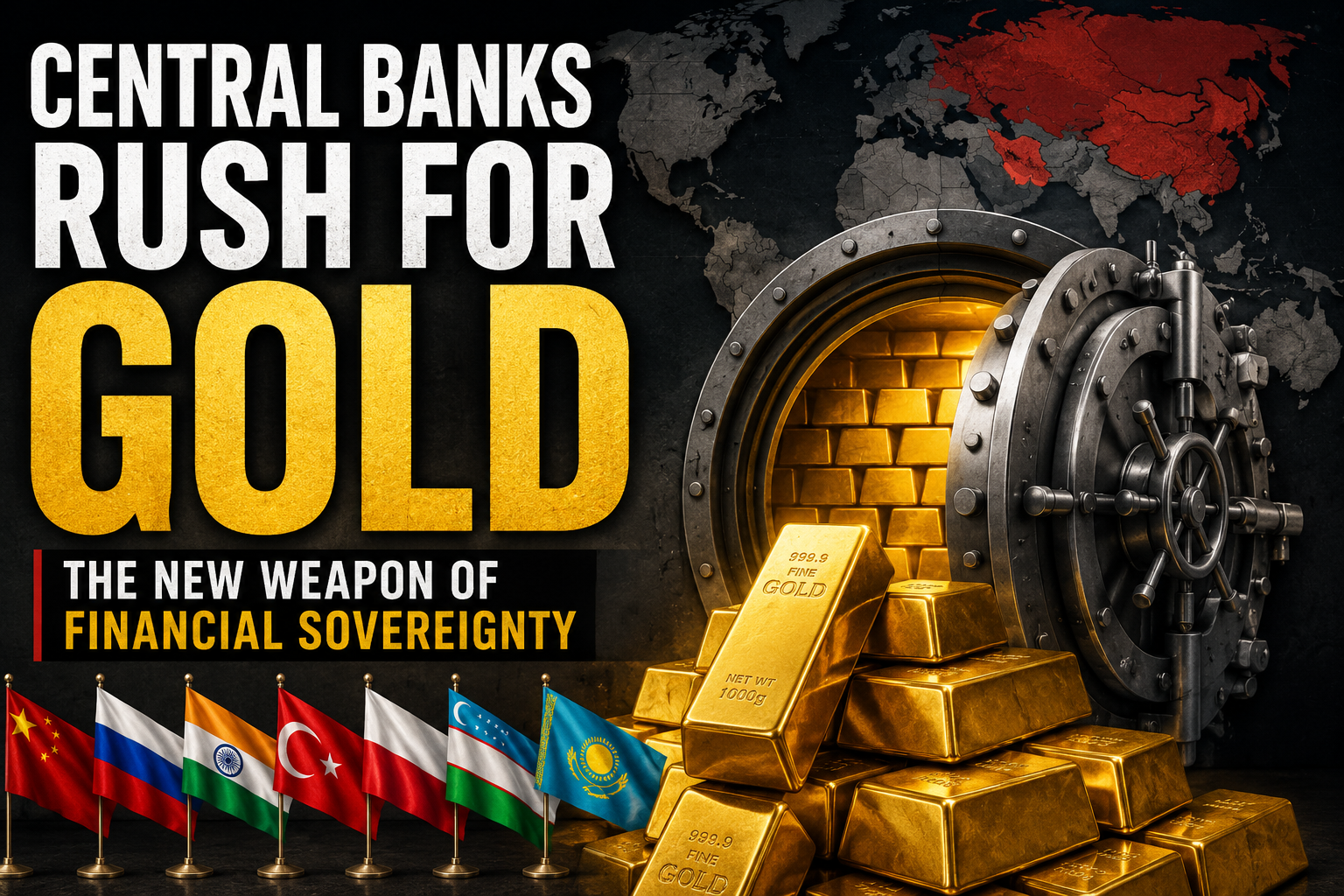
Central Banks Rush for Gold as Global Conflicts Reshape Reserve Strategy


As geopolitical tensions intensify across the globe, central banks are rapidly increasing their gold reserves in what analysts describe as a growing push for financial sovereignty.
While gold is often criticised as an inefficient asset due to storage costs and its lack of yield, reserve managers are buying it for one critical reason: it is one of the few reserve assets that cannot be frozen, sanctioned or defaulted on by another country.
Unlike dollars, which sit within the US Federal Reserve system, or euros held through the European Central Bank, physical gold stored in a nation’s own vault remains entirely under sovereign control. Even government bonds and US Treasuries rely on custodians and international financial infrastructure that can ultimately be restricted during periods of political conflict.
The shift accelerated sharply after 2022, when roughly $300 billion in Russian foreign reserves were frozen following the invasion of Ukraine. The move sent shockwaves through central banking circles and triggered renewed concern about the risks of holding large amounts of foreign currency reserves tied to Western financial systems.
Since then, central bank demand for gold has surged. Official data shows central banks purchased 244 tonnes of gold in the latest quarter alone, continuing a four-year trend of annual acquisitions exceeding 1,000 tonnes.
The buying is not limited to major powers. Poland added 31 tonnes last quarter, while Uzbekistan purchased 25 tonnes and Kazakhstan increased reserves by 13 tonnes. Analysts say the broad-based accumulation reflects a global reassessment of reserve security amid rising geopolitical fragmentation and conflict risks, including ongoing tensions involving Iran, Russia and the West.
The renewed appetite for bullion has also reinforced gold prices near record highs despite elevated global interest rates.
Market observers increasingly argue that gold is no longer simply a hedge against inflation or market volatility. Instead, it is becoming a strategic asset tied directly to national independence, with reserve holdings increasingly viewed as a measure of geopolitical resilience in an uncertain world.

Tradable assets:
Min.Deposit:
Max Leverage:
FCA:

Rating:
 Earnings Calendar
  Economic Calendar
  VAT Calculator
  Tax Free Childcare Calculator
 Percentage Calculator
 Compound Interest Calculator
  Loan Overpayment Calculator
 Mortgage Calculator
 Credit Card Calculator
 Investing
  Economics
 Trading
  Technical Analysis
  Personal Finance
 Calculator