News
Tesla Q3 Update and Its Impact on the Stock
04 Oct 2026, 10:00


Join Minipip Academy and access free courses in investing, trading, economics, and more.
Sign Up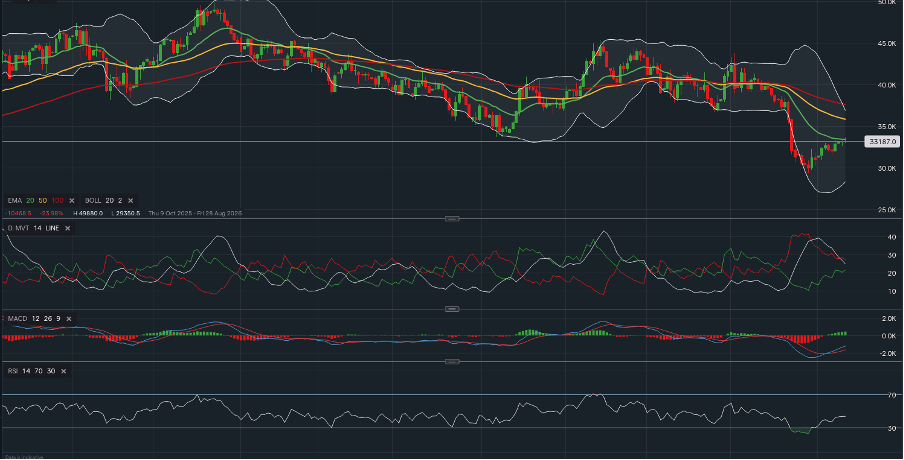


Tesla remains one of the world’s most influential and closely watched companies, sitting at the convergence of electric vehicles, artificial intelligence, autonomous driving, robotics and renewable energy. Unlike traditional automotive manufacturers, its valuation is driven less by current vehicle production and more by expectations of future technological leadership, resulting in significantly higher valuation multiples than most peers.
Figures taken at the time of writing 5th of August and 11th August
Tesla continues to command one of the highest valuations in the automotive sector, reflecting investor confidence in its long-term growth prospects rather than its current earnings profile. Trading at a trailing P/E ratio 308.28, compared with a forward P/E of 147.82, the significant compression indicates that analysts expect substantial earnings growth over the coming years. Although the forward multiple remains exceptionally high by conventional standards, it suggests the market anticipates improved profitability rather than assigning value solely to present-day financial performance.
With a market capitalisation of approximately $1.31 trillion, Tesla remains one of the world’s largest publicly traded companies. However, trailing twelve-month earnings of just $3.81 billion highlight the premium investors continue to pay for future growth. Based on the forward P/E, projected earnings imply a meaningful improvement in profitability over the next reporting periods, supporting expectations that operating margins may recover as production efficiencies improve and higher-margin software and energy businesses expand.
Tesla’s PEG ratio of 6.2, well above the auto parts industry average ratio of 0.53, suggests the shares remain expensive relative to expected earnings growth, indicating that a considerable proportion of future growth is already reflected in the current valuation. Likewise, the elevated Price-to-Book ratio of 15.09 is substantially above that of traditional automotive manufacturers, which typically trade below 1.5x book value due to their asset-intensive business models. Instead, Tesla’s valuation more closely resembles that of a technology company, where investors place greater emphasis on intellectual property, software capabilities, artificial intelligence, autonomous driving, energy storage and future innovation than on tangible assets alone.
Consequently, Tesla’s premium valuation leaves relatively little room for operational disappointment. Continued execution across vehicle deliveries, Full Self-Driving (FSD) development, energy storage deployment and broader artificial intelligence initiatives will likely remain critical in justifying these elevated multiples. Conversely, any sustained slowdown in earnings growth or delays in commercialising future technologies could place downward pressure on valuation as markets reassess long-term expectations.
Wall Street sentiment currently reflects a consensus Hold recommendation based on 28 analyst ratings, comprising 10 Buy, 15 Hold, and 3 Sell recommendations. This balanced outlook suggests analysts acknowledge Tesla’s exceptional long-term growth potential while remaining cautious about its elevated valuation and near-term execution risks. Price targets range from $377.43 to $505.00, illustrating the unusually wide dispersion of expectations that often accompanies disruptive growth companies. The average price target of $377.43 now implies approximately 14.1% upside from the current share price. Although analysts continue to expect modest appreciation, the reduction in implied upside suggests expectations have become more conservative, reflecting increased uncertainty surrounding Tesla’s near-term earnings trajectory, valuation and execution of its long-term growth strategy.
Key Drivers Supporting the Consensus
Analysts continue to highlight Tesla’s strong financial position as a major competitive advantage. Robust operating cash flow, positive free cash flow and relatively low leverage provide considerable financial flexibility to fund research and development, factory expansion and capital investment without placing significant strain on the balance sheet. In addition, the growing adoption of FSD subscriptions offers an increasingly attractive source of recurring, high-margin software revenue, reducing reliance on vehicle sales while improving customer lifetime value. Beyond automotive operations, continued expansion of Tesla’s energy storage business, particularly through Megapack deployments and grid-scale battery solutions, provides a further avenue for long-term revenue diversification, supported by accelerating global demand for renewable energy infrastructure and large-scale energy storage.
Despite these strengths, analysts remain mindful of several challenges that could limit future returns. Profitability has declined from previous peak levels as automotive margins have compressed, reducing returns on invested capital and limiting the company’s ability to generate incremental earnings from its expanding asset base. At the same time, Tesla’s substantial multi-year capital expenditure programme requires continued investment in manufacturing capacity, artificial intelligence infrastructure and future technologies, delaying returns on capital while increasing execution risk should demand weaken or projects fail to meet expectations. Furthermore, the energy generation and storage segment has experienced periods of margin volatility due to warranty provisions, supplier-related issues and changing tariff conditions, highlighting that this rapidly growing business remains exposed to operational and policy-related uncertainties that could affect future profitability.
|
Indicator |
5 Aug |
Today |
Interpretation |
|---|---|---|---|
|
EMA20 |
33,576 |
33,406 |
Price still below EMA20 but closer |
|
EMA50 |
36,294 |
35,816 |
Still well below medium-term trend |
|
EMA100 |
37,964 |
37,587 |
Long-term trend still bearish |
|
+DI |
17.07 |
21.58 |
Buyers strengthening |
|
-DI |
30.32 |
27.33 |
Sellers weakening |
|
ADX |
33.75 |
25.03 |
Trend losing strength |
|
RSI |
36.7 |
43.7 |
Momentum recovering toward neutral |
|
MACD Histogram |
163 |
437 |
Bullish momentum improving rapidly |
|
MACD |
-1875 |
-1231 |
Moving closer to zero |
|
Signal |
-2036 |
-1668 |
Bullish crossover strengthening |
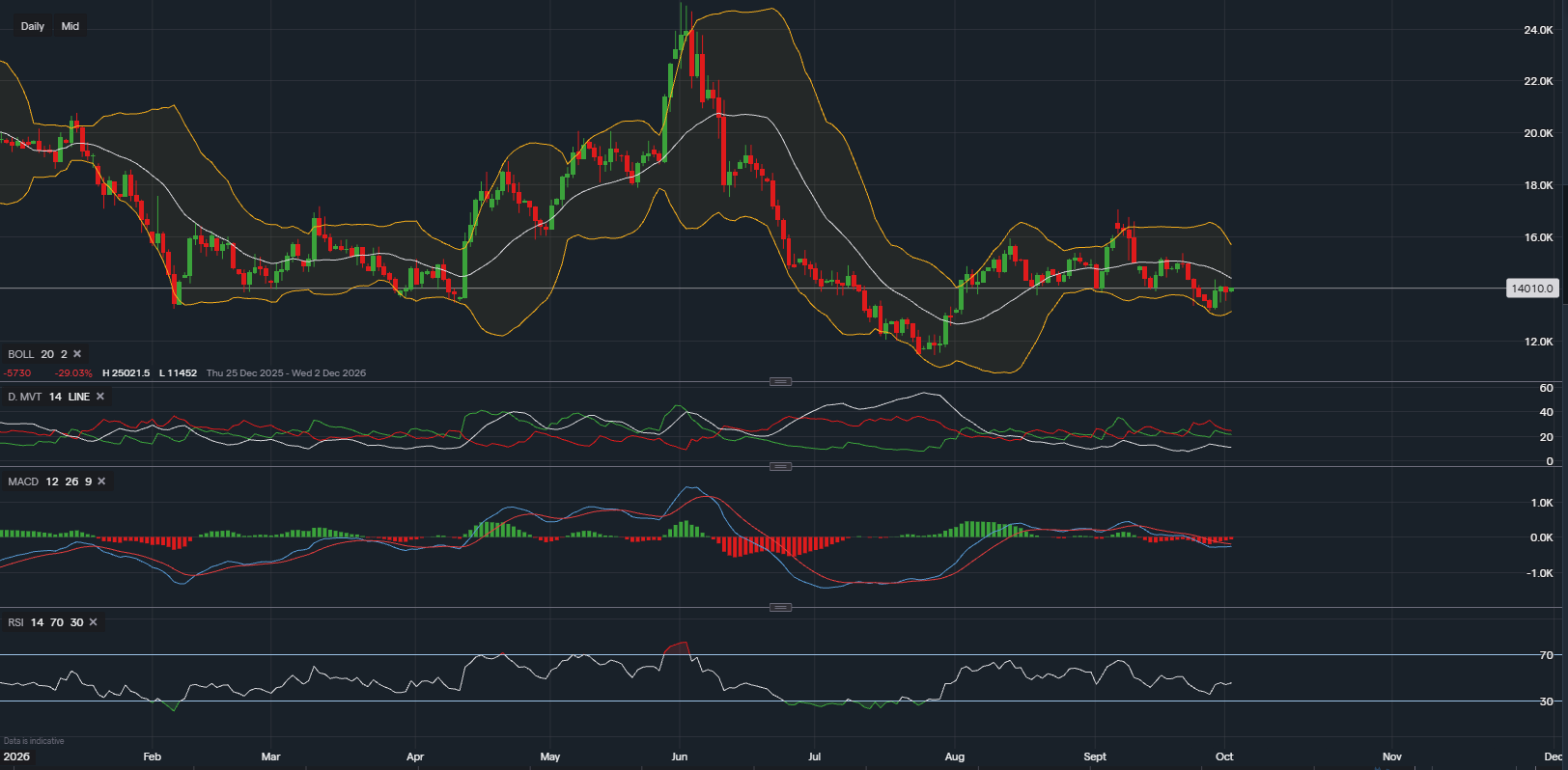
Tesla remains within a medium-term downtrend, with the share price continuing to trade below the 20-, 50-, and 100-day Exponential Moving Averages (33,406, 35,816 and 37,587 respectively). Although the overall trend remains bearish, the narrowing gap between price and the shorter-term moving averages suggests downside momentum has continued to weaken as buyers gradually re-enter the market.
The Directional Movement Index (DMI) now presents a more balanced picture than previously. While –DI (27.33) continues to exceed +DI (21.58), indicating sellers still retain control, the gap between the two has narrowed considerably. Furthermore, the ADX has fallen to 25.03 from the previous reading above 33, suggesting that the strength of the prevailing downtrend is beginning to fade rather than accelerate. This combination is often observed during the transition from a strong trending environment towards consolidation or the early stages of trend stabilisation.
Momentum indicators also show further improvement. Although both the MACD (-1,231) and Signal (-1,668) remain below zero, confirming that the broader trend remains negative, the MACD histogram has strengthened significantly to +436.7, indicating bullish momentum continues to build as bearish momentum fades. Likewise, the RSI has recovered to 43.7, moving closer to the neutral 50 level after previously emerging from oversold territory, reflecting improving buying pressure despite the absence of a confirmed bullish trend.
Volatility has also begun to contract. After rebounding from the lower Bollinger Band (28,301), Tesla is now trading towards the 20-period moving average (33,678), exhibiting characteristics of mean reversion following an extended sell-off. Such behaviour typically reflects a return towards the statistical average after prices become excessively stretched to the downside. However, sustained closes above the middle Bollinger Band, followed by recovery of the shorter-term moving averages, would be required before this recovery could be interpreted as the beginning of a broader trend reversal.
Price action continues to suggest Tesla is attempting to establish support within the historically significant demand zone that attracted buyers during mid-2025. The broader market structure remains bearish following completion of the earlier double-top (“M”) reversal pattern, which marked the transition from the previous uptrend into the current decline. However, recent trading differs from earlier weeks. Instead of accelerating lower, the market is now producing smaller candles, improving momentum readings and evidence of demand returning near long-term support. This behaviour is more consistent with a mean-reversion recovery or consolidation phase than a confirmed bullish reversal. Should price reclaim the 20-day EMA and subsequently establish higher highs and higher lows above the middle Bollinger Band, the probability of a broader trend reversal would increase. Conversely, failure to hold the current demand zone would reinforce the prevailing bearish structure and increase the likelihood of another test of the recent lows.
Educational Disclaimer
This content is for educational and informational purposes only and should not be considered financial advice. Always conduct independent research or consult a qualified financial professional before making investment decisions.

Tradable assets:
Min.Deposit:
Max Leverage:
FCA:

Rating:
 Earnings Calendar
  Economic Calendar
  VAT Calculator
  Tax Free Childcare Calculator
 Percentage Calculator
 Compound Interest Calculator
  Loan Overpayment Calculator
 Mortgage Calculator
 Credit Card Calculator
 Investing
  Economics
 Trading
  Technical Analysis
  Personal Finance
 Calculator