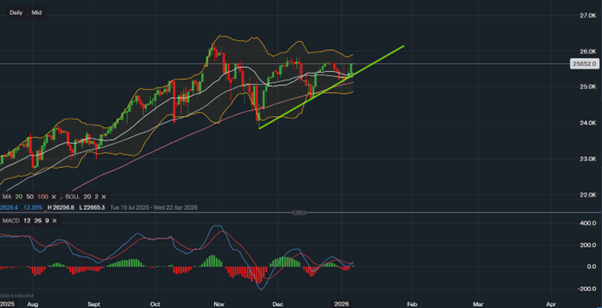
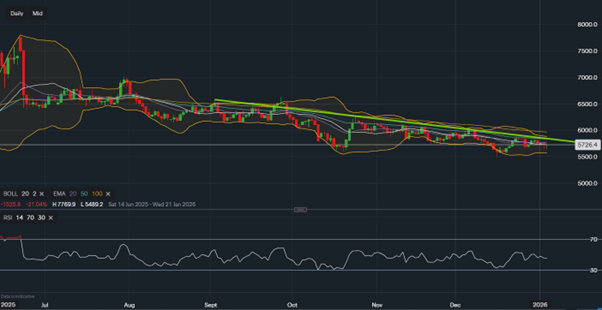
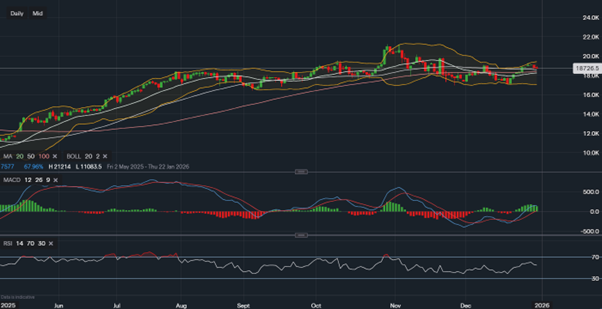
NASDAQ Outlook: Is a Bullish Rally Taking Shape?
$256.43
07 Jan 2026, 00:38
Bullish

Exxon Mobil Share Price Analysis: Bullish Momentum or Bearish Reversal Ahead?


Exxon Mobil has recently experienced a sharp bullish move, largely driven by renewed US political and military activity involving Venezuela. While this rally has strengthened short-term sentiment, it also raises an important question for traders and investors: is Exxon Mobil becoming overbought and vulnerable to a bearish reversal, or can the bullish momentum continue?
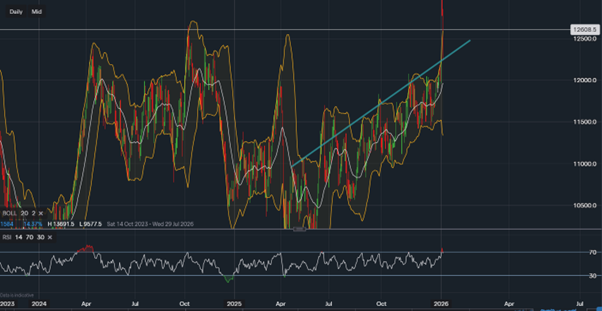
From a technical perspective, Exxon Mobil recorded a gap up on Sunday 4 January, a development that often signals heightened volatility and the potential for sharp price movements in either direction. While gap ups can support bullish continuation, they also increase downside risk if momentum fades.
Momentum indicators present a mixed picture. Exxon Mobil has recently entered overbought territory on the Relative Strength Index (RSI), and price action has touched the upper Bollinger Band. Both signals can indicate that the stock may be overstretched in the short term, increasing the likelihood of a pullback.
However, these bearish signals are counterbalanced by notable bullish developments. Price action has broken market structure to the upside and successfully pushed through the 20-, 50- and 100-day exponential moving averages (EMAs). This alignment typically suggests strengthening bullish momentum and improving trend confidence.
Overall, the technical outlook highlights uncertainty, suggesting traders may benefit from waiting for confirmation before committing to directional positions.
Fundamentally, Exxon Mobil appears reasonably valued. The stock currently trades at a price-to-earnings (P/E) ratio of 18.21, indicating fair value relative to historical averages, while the forward P/E of 17.60 suggests improving value expectations.
These valuation metrics imply estimated price ranges, with a high target of $130.15 (3.47% upside) and a low target of $127.97 (1.73% upside) based on fundamentals alone.
Analyst sentiment further supports a bullish bias, with consensus price targets averaging $132.58, representing an 8.10% upside. As analysts’ expectations exceed those implied by valuation models, Exxon Mobil could be considered undervalued, pointing to further upside potential if market conditions remain supportive.
Recent geopolitical developments have played a key role in Exxon Mobil’s price action. Donald Trump authorised US air strikes on Venezuela, alongside tighter sanctions and increasingly strong rhetoric surrounding the country’s oil industry. These actions have raised concerns about potential supply disruptions, which tend to support oil prices in the short term and, by extension, benefit major energy producers such as Exxon Mobil.
That said, Venezuela’s oil output is already at historically low levels, meaning the immediate impact on global supply — and therefore oil prices — may be limited.
Looking further ahead, if the US were to permit American companies to invest in and rebuild Venezuela’s oil infrastructure, global oil supply could increase. Any sustained rise in supply would likely place downward pressure on oil prices, potentially weighing on Exxon Mobil and the wider energy sector over the longer term.
Exxon Mobil currently presents a complex outlook. Bullish technical breakouts, supportive valuation metrics, and geopolitical tailwinds are offset by overbought conditions, elevated volatility, and longer-term supply risks.
Given the combination of mixed technical signals, conflicting fundamental and economic factors, and heightened volatility, traders and investors may be best served by waiting for confirmation before entering positions. A patient approach could help reduce unnecessary risk and improve trade accuracy in an uncertain market environment.

Tradable assets:
Min.Deposit:
Max Leverage:
FCA:

Rating: